
Twelve months ago, optimizing for AI search essentially meant optimizing for ChatGPT. Everything else was a rounding error.
That is no longer true, and the speed of the change is the story. ChatGPT lost more than 20 points of market share in a single year without losing users, because the category grew faster than it did. Anyone still running a ChatGPT-only visibility strategy is now missing close to half the market.
Here is where the share actually went.
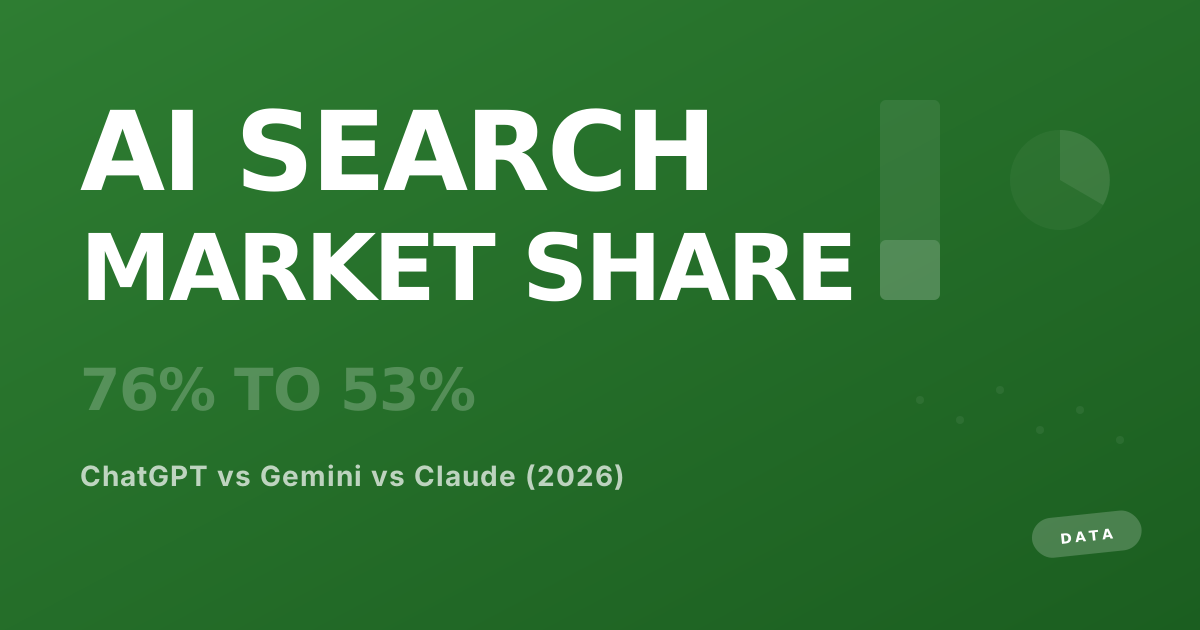
ChatGPT's share of generative AI web traffic fell from roughly 76% in June 2025 to about 53% in May 2026. Gemini took most of the difference, rising from under 9% to around 27% to 28%. Claude quadrupled from roughly 2% to 9%. The category grew 70% year on year, so this is redistribution during expansion, not decline.
What is the AI search market share in 2026?
Similarweb tracked generative AI website traffic worldwide across the twelve months to May 2026 and found a clear redistribution (Similarweb, 2026 Generative AI Landscape Report).
ChatGPT went from about 76% of worldwide generative AI web traffic in June 2025 to roughly 53% in May 2026. Gemini climbed from under 9% to around 27% to 28%. Claude moved from roughly 2% to close to 9%, which is the largest proportional gain of any platform tracked, roughly quadrupling its share (Similarweb).
The context that stops this being a decline story: the whole category expanded. Generative AI sites averaged 9.5 billion monthly web visits, up 70% year on year, from 655 million unique visitors, up 57%, with 4.4 billion app downloads, up 58% (Similarweb).
ChatGPT holding 53% of a market that grew 70% is not a business in trouble. It is a business that stopped being the only option.
| Platform | June 2025 | May 2026 | Change |
|---|---|---|---|
| ChatGPT | ~76% | ~53% | Down ~23 points |
| Gemini | Under 9% | ~27-28% | Up ~19 points |
| Claude | ~2% | ~9% | Up ~7 points |
| Category total visits | 5.6B/month | 9.5B/month | Up 70% |
Why did Gemini grow so fast?
Distribution, not persuasion. Gemini did not win an argument about model quality. It won because Google put it in front of people who were already there.
Gemini passed 750 million monthly active users by Google's Q4 2025 earnings call (Google), and AI Overviews, which are powered by the same family of models, reached 1.5 billion users monthly across more than 200 countries (Google, Q1 2025 earnings).
That distinction matters for visibility work. A ChatGPT user made a decision to open ChatGPT. A Gemini or AI Overviews user often made no decision at all, they simply searched Google and received a generated answer. The second group is far larger and far less deliberate, which means AI Overviews visibility reaches people who would never have opened an AI assistant on purpose.
ChatGPT visibility reaches people who chose to ask an AI. Google AI Overviews visibility reaches everyone who searched Google. The second audience is bigger and requires no behavior change from your customers.
Is Claude worth optimizing for?
On present share, Claude is the smallest of the three major platforms. On trajectory, it is the fastest growing.
Claude went from roughly 2% to close to 9% of generative AI web traffic in twelve months (Similarweb), and its worldwide app monthly active users grew by approximately 1,318% over the same period, with worldwide growth running dramatically higher than US growth (Similarweb).
Anthropic does not publish user counts, so treat any specific Claude user number you see with suspicion. The credible Anthropic-sourced material is the Economic Index research, which analyzed 1 million conversations in September 2025 and 2 million in the January 2026 edition, and reports Claude usage across more than 150 countries (Anthropic).
The honest answer on whether to optimize for Claude specifically: not as a separate workstream. The work that earns Claude citations is the same work that earns ChatGPT and Perplexity citations, which is credible, well-structured, frequently referenced content. Claude is a reason to keep going, not a reason to build something new.
Where does Perplexity fit?
Perplexity is the smallest of the four by traffic and the most interesting by user intent.
Perplexity has reported roughly 45 million active users and 780 million monthly queries, with growth above 370% year on year, and raised at a $20 billion valuation in September 2025 (TechCrunch).
The reason it matters out of proportion to its size is that Perplexity is built citation-first. Every answer carries visible sources. Users arrive expecting to click through, which makes Perplexity referral traffic behave more like traditional search traffic than ChatGPT referral traffic does. Our guide on how to rank in Perplexity covers the specifics, and how Perplexity chooses sources covers the mechanism.
Which platform sends the most referral traffic?
ChatGPT, and it is not close, though the total remains modest against Google.
ChatGPT accounts for more than 80% of AI referral traffic to websites, up 30% on the previous study (Ahrefs). AI platforms together generated 1.13 billion referral visits in June 2025, up 357% year on year (Similarweb via TechCrunch).
Set against that, Google still sends around 345 times more traffic to websites than ChatGPT, Gemini and Perplexity combined (Ahrefs). AI traffic has grown 9.7x in a year and 63% of websites now receive some, but the average site draws about 0.25% of its traffic from AI sources (Ahrefs).
One structural change worth knowing: ChatGPT altered its referral behavior in May 2026, and the share of its referral traffic landing on site homepages rose from around 26% to 29% up to roughly 62% to 63%, a change that has held rather than faded (Similarweb). If your AI referral traffic started arriving at your homepage instead of your deep pages, that is why, and it makes your homepage a more important AEO asset than it was.
Does market share change what you should actually do?
Mostly it changes coverage, not method.
The underlying work is stable across platforms because they draw on similar signals. Yext's analysis of 6.8 million AI citations found 86% came from brand-managed sources, split 44% first-party websites and 42% business listings (Yext). Ahrefs found branded web mentions carried the strongest correlation with AI visibility, at 0.664 (Ahrefs).
Neither of those is platform specific. Fix your first-party content and your listings, earn credible mentions, and you improve across all four engines at once.
What market share should change is how you measure. Tracking ChatGPT alone gave a reasonable picture of AI visibility in 2025. In 2026 it covers roughly half the market and misses the fastest-growing platform entirely. If your reporting still has one column, it is now measuring the wrong thing. Our guide to checking your business in AI search walks through covering all of them.
How to read market share data without being misled
Three traps catch people reading these numbers, and all three produce bad decisions.
Share of traffic is not share of users. Similarweb measures website visits, which favors platforms people use through a browser and undercounts platforms used mainly through apps or embedded in other products. Gemini appears inside Google Search, Workspace and Android, and much of that usage never shows up as a visit to a Gemini domain. The 27% to 28% figure is therefore a floor for Gemini's reach, not a ceiling.
Absolute growth and relative share move in opposite directions. ChatGPT losing 23 points of share while the category grew 70% means its raw traffic still increased. Any headline reading "ChatGPT collapses" is confusing the two. The correct statement is that competitors grew faster from a smaller base.
User counts are not comparable across companies. OpenAI reports weekly active users, Google reports monthly active users, and Anthropic reports nothing at all. Comparing 800 million weekly ChatGPT users to 750 million monthly Gemini users is comparing different measures on different windows, and it flatters whichever one you quote second.
If a market share figure does not tell you what it measured, over what period, and from what data, treat it as marketing rather than research. That applies to figures that favor our argument as much as ones that do not.
The measure that actually matters for your business is none of these. It is how often each platform names you for the questions your buyers ask, which is a per-business number no market share report can give you.
Which engines mention you, and which mention your competitors?
Book a free AI Visibility Audit. We check ChatGPT, Google AI Overviews, Gemini, Perplexity and Claude, and show you where you stand on each.
Book Your AI Visibility AuditFrequently Asked Questions
Which AI search platform is biggest in 2026?
ChatGPT, at roughly 53% of worldwide generative AI web traffic as of May 2026, down from about 76% a year earlier. Gemini is second at around 27% to 28%, Claude third at close to 9% (Similarweb).
Is ChatGPT losing users?
No. It lost share, not users. The category grew 70% year on year in monthly visits (Similarweb), so ChatGPT can hold a much smaller percentage of a much larger market while still growing in absolute terms.
Should I optimize for every AI platform separately?
No. The signals that drive citations overlap heavily across engines, and 86% of AI citations come from brand-managed sources such as your own site and your listings (Yext). Do that work once and it lifts every platform. What should be platform-specific is your measurement, not your method.
Why did my AI referral traffic start landing on my homepage?
ChatGPT changed its referral behavior in May 2026, and homepage referrals rose from roughly 26% to 29% up to about 62% to 63% of its referral traffic (Similarweb). The change has persisted, so your homepage now carries more AEO weight than it used to.
How reliable is AI search market share data?
Traffic-based measures such as Similarweb's are the most defensible, because they measure observed visits rather than survey responses. Be wary of market share figures with no stated methodology, and of user counts for Anthropic, which does not publish them.

Ashur Homa
Built and scaled a digital brand to $100M+ in sales with zero ad spend. Has helped businesses generate millions through AI go-to-market strategy. Leads growth at Omni Eclipse.
Connect on LinkedIn