


Overview
Big companies run their work across separate systems: ALM, DevOps, ITSM and PLM. Getting those systems to talk to each other is hard, and expensive to get wrong.
OpsHub makes the software that does it. They move and connect work across the systems big companies actually run on.
Ask AI how to do that job and it now builds the answer out of OpsHub's own pages in more than four answers in ten. Four months ago it barely opened their site at all.
The buying question here is very exact. Can you move years of work from one system to another? Without losing the history, the comments, the files and the links between them? People used to research that through vendor comparisons and forum threads. Now they ask AI. And AI answers with a shortlist.
So there are two jobs, not one. Getting on the shortlist is the first. Being the website AI reads to build that shortlist is the second - and that one decides how you get described.
We started with OpsHub in late May 2026. Across the buying questions we track for them, how often AI reads their own site has tripled.
“What we do is genuinely hard to explain in one line, and for a long time AI was explaining it for us using everybody else's pages. Omni Eclipse worked out which questions our buyers were actually asking and got our own answers in front of them. The people who reach us now already understand what we do before the first call, which changes that conversation completely.
We started with OpsHub in late May 2026. We built the pages that answer the questions their buyers ask, then tracked those questions every day across Google AI Overviews, Gemini and ChatGPT. On those questions, how often AI cites OpsHub's own site went from 14% of answers to 42%. Being named climbed too, from 30% to 40%. These figures cover the questions we track, not the whole website.
The challenge
-
AI talked about them, but did not read them. Across the questions we track, AI named OpsHub in about three answers in ten. It read OpsHub's own website in fewer than one and a half in ten. So AI was describing a very technical product using other people's pages. Round-ups, directories, forum threads. OpsHub had no say in how they were described.
-
The answer was already crowded. Questions about connecting these systems pull in documentation, vendor round-ups, directories and forum threads. A specialist has to earn a place in an answer that plenty of other sites are already filling.
-
The questions worth the most are the ones tools tell you to ignore. "How much does an ALM data migration cost when history and attachments must be preserved?" gets almost no search volume, so a keyword tool scores it as worthless. But nobody types that unless they have already decided to do the job and are working out who to call. AI answers it in full regardless of how few people ask, and whoever it names is on the shortlist. On Google, a question nobody searches is a page nobody reads. AI does not work that way. It answers the question properly however few people ask it, so the buyer with the budget gets a real answer, and almost nobody is competing to be in it.
The approach
We ran our four-step method: find the questions, answer them properly, get into the sources AI reads, then track what moves.
The results
How often AI cites their own site tripled
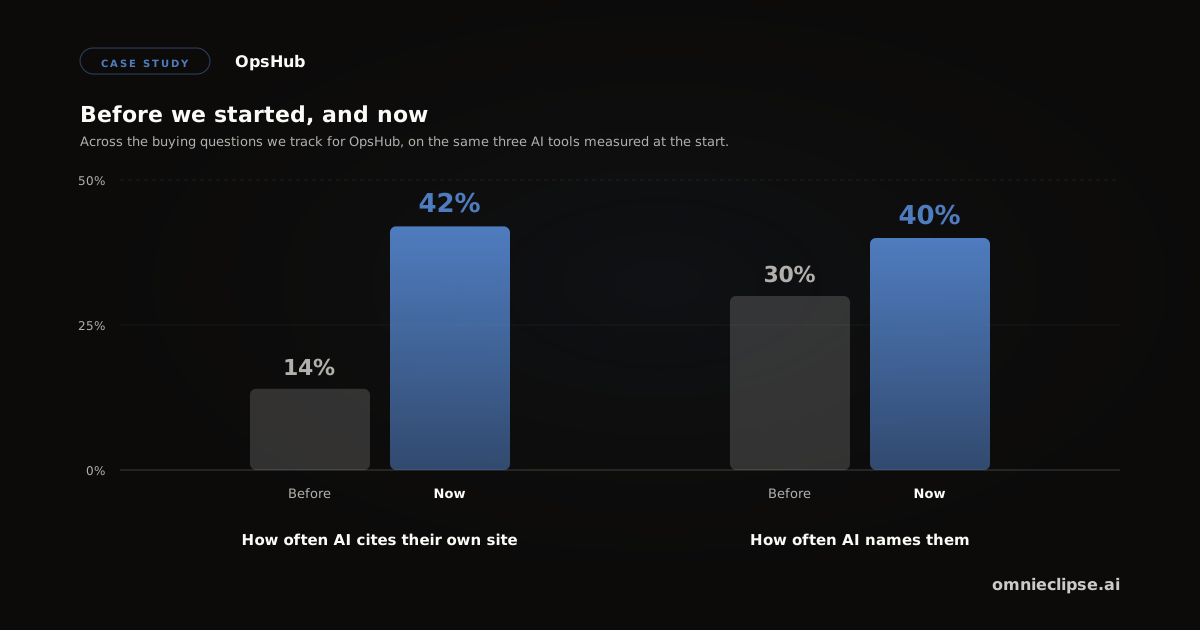
Before the first page went live, AI cited their own site in 14% of answers to the questions we track. Today it is 42%. Every figure on this page is measured on those questions, on the same three AI tools measured at the start, not across the whole website.
| What we measure | Before | Now | Change |
|---|---|---|---|
| How often AI cites opshub.com | 14% | 42% | +28 points |
| How often AI names OpsHub | 30% | 40% | +10 points |
Being named went up too, by ten points. But that was never the hard part.
The number that matters is how often AI cites their own site. That is the one that tripled. AI was already talking about OpsHub. What changed is whose words it used.
The pages AI opens
Whose words end up in the answer comes down to which pages AI opens to write it. These are the five OpsHub pages it opened most over the last fortnight. Every one of them was built for this work.
- Best tools to sync incidents between ITSM and DevOps teams
- Best ALM, DevOps, ITSM and PLM toolchain integration
- What is the best ALM migration tool for software teams
- Big bang versus phased ALM tool migration
- What an ALM data migration costs when history and attachments must be preserved
AI opened every one of those pages more often than it opened the opshub.com homepage. Pages written to answer a single buying question are doing more work in AI answers than the front door of the site.
AI explains what the product does, not just that it exists
This is the part traditional search cannot do. A search result gives you a link and hopes the buyer clicks. An AI answer describes your product to the buyer inside the answer, whether they click or not.
So the useful question is not only how often AI names you. It is what AI says when it does.
Here is one, word for word:
“Fast time-to-value: Integration platforms (such as OpsHub Integration Manager) connect existing tools in weeks, avoiding multi-year migration projects. Minimal disruption: Development, QA and IT support teams keep their preferred native interfaces.
Nobody clicked anything to read that. For a product that is hard to explain in a headline, having AI make the argument for you is worth more than the ranking.
Where AI names them most
The overall number is the summary. Single questions are where the money is. These are the questions a buyer asks right before they build a shortlist, and where AI stands on each of them now.
| What buyers ask | How often AI names them |
|---|---|
| Who provides the best integration for ALM, DevOps, ITSM and PLM toolchains? | 100% |
| Which ALM migration vendors preserve work item links, comments, attachments and history? | 100% |
| Which ALM integration vendors can synchronize comments, attachments, links and hierarchy data? | 100% |
| Which integration platforms synchronize test cases, traceability links, attachments and hierarchy data across ALM and DevOps tools? | 100% |
| Which ALM migration vendors reduce the risk of losing history, attachments and custom fields? | 100% |
| Who provides secure ITSM to DevOps integration with field-level controls? | 86% |
| Who are the most trusted partners for migrating legacy ALM systems to modern platforms? | 76% |
| Best tools to sync incidents between ITSM and DevOps teams in 2026 | 76% |
| What is the best ALM migration tool for software teams? | 71% |
On the five questions at the top of that table, AI named OpsHub in every answer it gave us last week, on all three AI tools.
Their biggest buying question
"What is the best ALM migration tool for software teams?" is about as close to a ready buyer as this category gets. AI names OpsHub in 71% of answers to it.
“The best Application Lifecycle Management (ALM) migration tool depends on your specific platforms, but OpsHub Migration Manager is widely considered the top purpose-built solution. It specializes in high-fidelity data migration, preserving complex work item hierarchies, history, and attachments with minimal downtime.
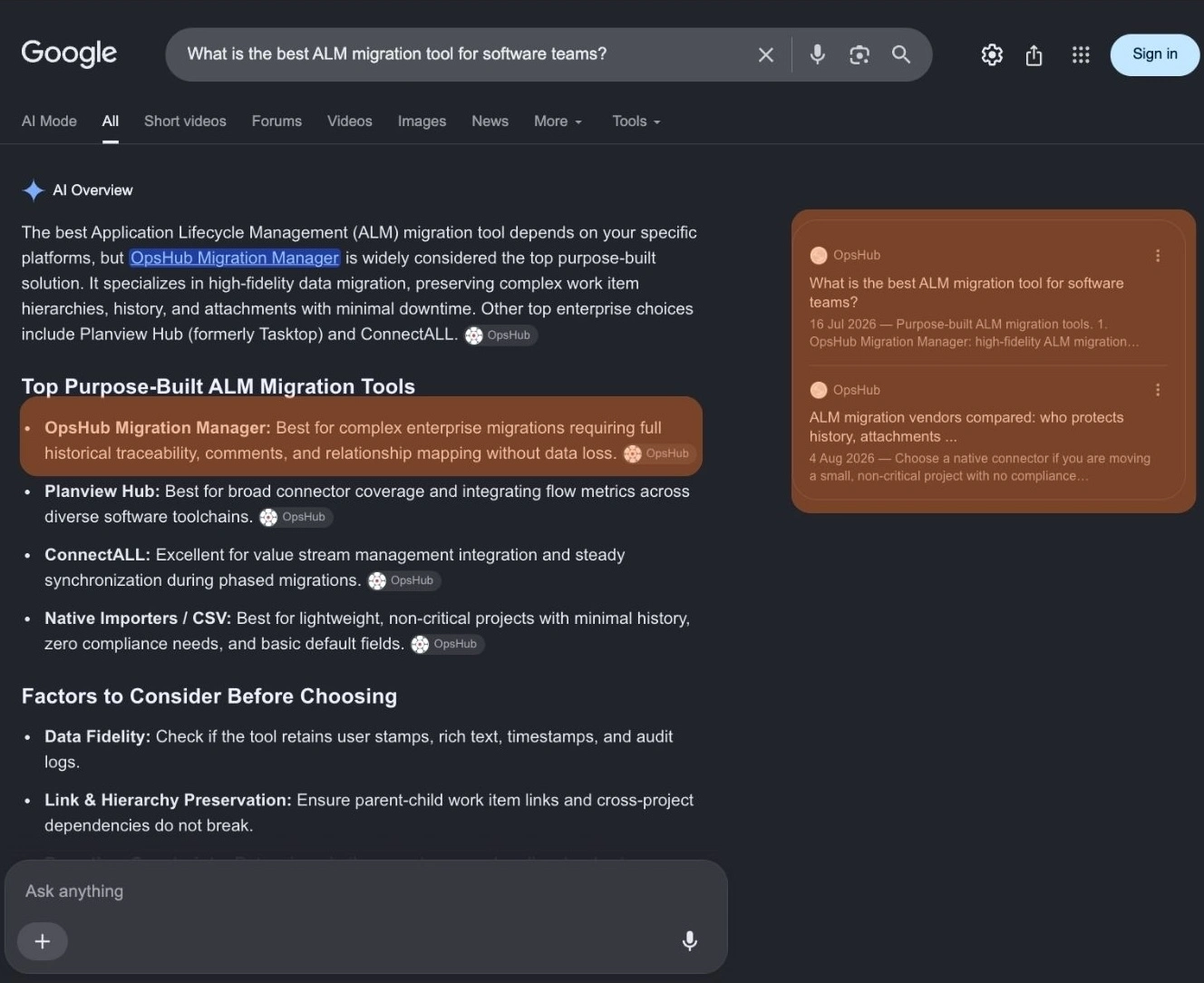
Google's AI Overview for "What is the best ALM migration tool for software teams?". OpsHub Migration Manager is named first and called the top purpose-built solution, and both sources Google shows on the right are OpsHub's own pages.
The bigger picture
OpsHub's results show what AI search does for a specialist in a crowded category.
On Google, a page has to out-rank twenty years of accumulated links before anyone reads it, and writing something better does not move that on its own.
AI works differently. It builds an answer from whichever sources handle the question best. And "how do I move work between these two systems without losing the files" is a question a specialist answers better than almost anyone. That is exactly what happened here.
The shift is real and growing. McKinsey found 44% of people now prefer AI over normal search when deciding what to buy (Oct 2025). That figure is about shoppers, not big companies, but it points the same way as what we measured. Gartner expects normal search to drop 25% by 2026. And Ahrefs found people arriving from AI buy more often than people from normal search (Jun 2025).
Buying this kind of software takes months, and the shortlist gets written long before anyone fills in a form. OpsHub moved early. On the questions we track, AI now cites their own pages in more than four in ten of the answers their buyers see, up from fewer than one and a half in ten.
Want results like OpsHub's?
Book a free AI Visibility Audit. We'll show you where you stand in AI search today, where you're missing from answers, and what it would take to change that. Results vary by category and are not guaranteed.
Book Your AI Visibility Audit
Ashur Homa
Built and scaled a digital brand to $100M+ in sales with zero ad spend. Has helped businesses generate millions through AI go-to-market strategy. Leads growth at Omni Eclipse.
Connect on LinkedIn