Ranking on Google page one is the thing every business has been told to want. We checked whether it still buys you anything in AI search.
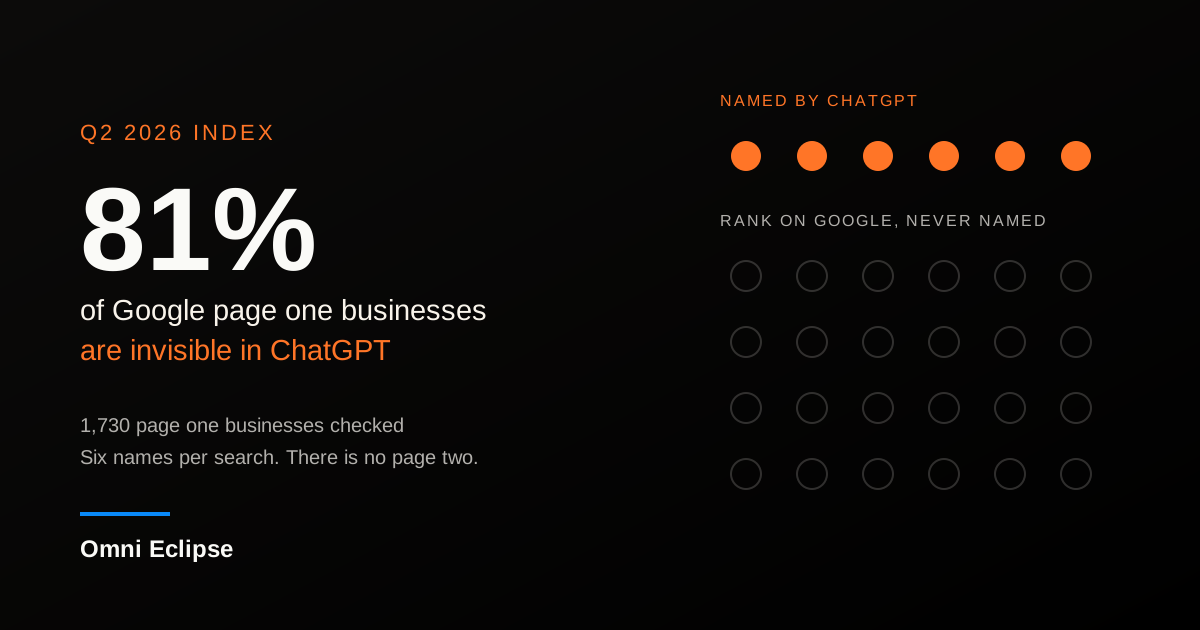
It does not. Of 1,730 businesses holding a Google page one position for a buying query, 81% do not appear in ChatGPT's answer to that same query.
These are not businesses buried on page four. Every single one of the 1,730 ranks in the top ten organic results on Google for the exact query we tested. They won the search battle everyone has been fighting for twenty years, and four out of five of them are not in the answer.
This index draws on two collections. The visibility rate comes from a fresh sample of 271 buying queries and 1,730 page one businesses, measured in August 2026. The shortlist and industry structure come from the Q2 corpus of 1,107 queries and 11,990 businesses collected in April and May 2026. The methodology section at the end sets out how each was gathered and where they differ.
How many Google page one businesses are invisible in ChatGPT?
81.2%. We checked 1,730 businesses and 326 of them appeared in ChatGPT's recommendation. The other 1,404 did not.
The population matters here. Our Q1 2026 report checked 1,700 businesses at every Google depth and found 88.1% invisible, with a page one subset of 356 businesses that was 77% invisible. This index takes that page one question and puts nearly five times the sample behind it. The answer holds, and if anything it has hardened.
Directories, listicles, review aggregators and news sites were excluded before counting, so the 1,730 are businesses competing in the category rather than pages ranking about the category. That exclusion matters: it is why the figure is a statement about businesses, not about search results.
Which industries are worst for AI search visibility?
College admissions consulting, where 92.9% of page one businesses are absent from the AI answer. Family law is the most forgiving at 66%, and even that means two in three page one firms are missing.
| Industry | Businesses checked | Invisible in ChatGPT |
|---|---|---|
| College Admissions Consultants | 42 | 92.9% |
| Bankruptcy Lawyers | 81 | 87.7% |
| Luxury Real Estate Agents | 70 | 87.1% |
| Wedding Venues | 46 | 87.0% |
| Tax Accountants | 102 | 86.3% |
| Credit Repair Services | 54 | 85.2% |
| Web Design Agencies | 65 | 84.6% |
| Financial Advisors | 143 | 82.5% |
| Commercial Insurance Brokers | 119 | 82.4% |
| Business Brokers | 119 | 82.4% |
| Personal Injury Lawyers | 157 | 81.5% |
| Luxury Car Dealerships | 78 | 80.8% |
| Mortgage Brokers | 67 | 77.6% |
| Wealth Management Firms | 58 | 75.9% |
| Recruitment Agencies | 48 | 75.0% |
| Weight Loss Clinics | 44 | 72.7% |
| Immigration Lawyers | 155 | 71.6% |
| Family Lawyers | 53 | 66.0% |
Not one industry in the study drops below 66%. There is no category where ranking on Google page one gives you better than a one in three chance of being in the AI answer, and in most it is closer to one in six.
The spread is worth reading carefully. The categories at the top of the table tend to be ones where the buying decision is high consideration and heavily reviewed, which is exactly where you would expect an AI answer to lean on third party signals rather than on whoever ranks. The categories at the bottom, immigration and family law, are ones where directory and professional body citations are dense and consistent, which is the kind of signal that survives the jump from Google to an answer engine.
Does AI search visibility vary by country?
Yes, and the United Arab Emirates is the outlier. 91.5% of page one businesses there are invisible in ChatGPT, against roughly 80% in the other three markets.
| Country | Businesses checked | Visible in ChatGPT | Invisible |
|---|---|---|---|
| United Arab Emirates | 106 | 8.5% | 91.5% |
| United States | 943 | 18.8% | 81.2% |
| Australia | 319 | 20.4% | 79.6% |
| United Kingdom | 362 | 20.7% | 79.3% |
The United States, Australia and the United Kingdom cluster within 1.9 percentage points of each other, which suggests the underlying mechanism is not market specific. The UAE gap is large enough to be interesting rather than noise, though at 106 businesses it is the smallest cell in the study and should be treated as directional.
How many businesses does ChatGPT actually name?
Six. This is the other half of the story, and it explains the 81%.
Across the Q2 corpus of 1,107 buying queries, ChatGPT named a mean of 6.0 distinct businesses per query, with a median of 6. 96% of queries returned eight or fewer. 41% returned five or fewer.
Google's first page holds ten results. ChatGPT's holds six, and there is no page two to be relegated to. That is the whole arithmetic of the 81%: a page one that fits ten businesses feeding an answer that names six, in categories where far more than ten businesses are competing.
The shortlist also does not scale. It sits between 5.7 and 6.3 businesses across all four countries, and between 4.6 and 7.4 across every industry, no matter how crowded the market underneath it gets. In web design, 27.4 Google ranked businesses per query go unnamed. In hair restoration it is 3.3. The number of slots does not move to accommodate either.
Why doesn't ranking on Google carry over to ChatGPT?
Because the two systems read different signals to answer different questions.
Google is assembling a list of documents you might want to read, ranked on links, domain authority and page relevance. ChatGPT is answering a question, and a good answer to "who is the best X in Y" is not thirty options. It composes recommendations from entity recognition, review aggregation, citation frequency across third party sources, and structured business data. A business can hold an excellent Google position on signals that carry no weight in the second system. We covered the mechanics in AEO vs SEO and in how ChatGPT recommends businesses.
The consumer behavior is what makes this consequential rather than academic. McKinsey's New Front Door to the Internet report found 44% of consumers now prefer AI search for buying decisions, against 31% for traditional search. Bain & Company found about 80% of search users rely on AI generated results for at least 40% of their searches, and that roughly 60% of searches now end without a click through to any website. ChatGPT reports 800 million weekly active users (Sam Altman via TechCrunch, Oct 2025) and holds around 68% of the AI chatbot market (First Page Sage, Feb 2026).
An 81% invisibility rate on page one would be a curiosity if AI search were a fringe channel. At this level of adoption it is most of your category's discovery, happening in a place your Google ranking does not reach.
What should a business on page one actually do about it?
Stop treating the Google ranking as evidence and start measuring the thing directly.
Three points follow from the data. Your ranking tells you nothing about your AI visibility. 1,404 businesses in this study are the proof. If your plan rests on "we rank well," you are reasoning from a signal this study shows is close to uncorrelated with the outcome.
Category density sets your difficulty. The industry table is a competitive map. A web design agency competing against 27 other page one businesses for six slots needs a much sharper position than a hair restoration clinic competing against three. Narrowing to a defensible niche is not branding, it is how you change which shortlist you are on.
Measurement has to be per query. With six slots, visibility is close to binary per query and highly variable across them. Averages hide this. Track a spread of real buying prompts and you will find you are in the six for some and absent for others, which is where the work gets planned. Our guide on how to check whether your business appears in AI search walks through doing it manually.
BrightEdge research indicates 40% to 60% monthly citation churn in ChatGPT. The six businesses named in your category this month are not guaranteed to be the six next month. That cuts both ways: incumbents cannot coast, and the 81% are not locked out.
How was this index built?
Two collections, gathered differently, and it is worth being precise about which figure comes from which.
The visibility rate. In August 2026 we drew a stratified sample of 271 buying queries from our Q2 query set, covering four countries. For each query we retrieved the Google organic results and an AI search response for the identical query, then recorded for every business whether it appeared in the AI answer. A business was counted as visible if the answer linked to its domain or named it exactly. Directories, review aggregators, listicles, news and government sites were excluded before counting. Every business in the final set ranked in the top ten organic Google results, which is why this is stated as a page one figure. 271 queries returned 1,730 businesses with no failed queries.
The shortlist and scale figures. The Q2 corpus was collected in April and May 2026 across 1,107 buying queries, 30 industries and four countries. It contains 11,990 unique businesses confirmed absent from ChatGPT, deduplicated from 12,280 records. This corpus retained the full AI response for every query, which is where the six businesses per search figure comes from, but it did not retain the businesses that were visible. That is why the visibility rate is drawn from the August sample rather than from it.
| Q1 2026 report | Q2 2026 index | |
|---|---|---|
| Collection | Jan to Mar 2026, manual | Apr to May 2026 corpus, Aug 2026 rate sample |
| Businesses | 1,700 at all Google depths | 1,730 on page one, plus 11,990 in the corpus |
| Countries | Australia, UAE, US | Australia, UAE, UK, US |
| Buying queries | Not reported separately | 1,107 corpus, 271 rate sample |
| Headline | 88% invisible, all depths | 81% invisible, page one only |
| Page one figure | 77% invisible (356 businesses) | 81.2% invisible (1,730 businesses) |
The Q1 report was collected by querying ChatGPT manually. This index used a programmatic AI search response for each query. Those are related but not identical systems, so treat the movement from 77% to 81.2% as directional rather than as a precise trend. The 81.2% figure stands on its own sample of 1,730 page one businesses. Q3 will repeat this exact method, which gives a like for like comparison from that point forward.
Are you in the six, or the 81%?
Book a free AI Visibility Audit. We'll run your real buying queries through ChatGPT, Perplexity, Gemini and Google AI Overviews, show you which shortlists you're on, and tell you what's keeping you off the rest.
Book Your AI Visibility AuditFrequently Asked Questions
What does the 81% actually measure?
The share of businesses ranking in Google's top ten organic results for a buying query that do not appear in the AI answer to that same query. We checked 1,730 such businesses across 271 queries in four countries. 326 appeared and 1,404 did not.
Why is this figure lower than the 88% in your Q1 report?
They measure different populations. The Q1 figure of 88.1% covered businesses at every Google depth, including pages two through five, where visibility is far lower. Its page one subset was 77% invisible across 356 businesses. This index measures page one only, at nearly five times the sample. Comparing 81.2% against 88.1% is comparing page one against all depths, which is not a like for like read.
Does appearing on Google page one help at all?
On this evidence, not much. Fewer than one in five page one businesses appear in the AI answer, and no industry in the study exceeded 34% visibility. Google rank is not a proxy for AI visibility, and the data does not support treating it as one.
Which AI platforms does this cover?
ChatGPT only, for comparability with our Q1 report and because it holds roughly 68% of the AI chatbot market (First Page Sage, Feb 2026). Perplexity, Gemini and Google AI Overviews use different retrieval methods and produce different shortlists. Our work on the retrieval gap between being cited and being recommended covers how they diverge.
How reliable are the country and industry breakdowns?
The United States rests on 943 businesses, the United Kingdom on 362 and Australia on 319, which is enough to be confident in. The UAE cell is 106 businesses and should be read as directional. Industry rows are reported only where at least 40 businesses were checked, and the largest, personal injury law, covers 157.
Can I see the underlying data?
Yes. The verification sample lists every business checked, its domain, its Google position and whether it appeared in the AI answer. Ask us and we will send it over.

Ashur Homa
Built and scaled a digital brand to $100M+ in sales with zero ad spend. Has helped businesses generate millions through AI go-to-market strategy. Leads growth at Omni Eclipse.
Connect on LinkedIn