We checked 1,700 businesses across 32 industries to find out how many actually show up when someone asks ChatGPT for a recommendation. 88% don't.
This is not a prediction based on survey data. This is not a projection from a sample of 50 companies. Between January and March 2026, we manually queried ChatGPT for recommendations across 32 industries in Australia, the UAE, and the United States, then recorded whether each business appeared in the response. One by one. 1,700 times.
The result is the most comprehensive ground-level AI search visibility study we're aware of. And the findings should concern every business that relies on search to generate leads.
For each industry and location, we asked ChatGPT a natural buying query: "best [industry] in [city]" or "best [industry] in [country]." We then recorded every business that appeared in the response. Each company was marked as either visible (Yes) or invisible (No). Only businesses with a confirmed status were included. Industries were consolidated from city-level data into parent categories (for example, all Australian buyers agent cities were combined into one "Buyers Agents" industry). Full methodology details are in the FAQ section below.
How Many Businesses Actually Appear in AI Search Results?
About 1 in 8. Of the 1,700 businesses we checked, only 202 appeared in ChatGPT's recommendations. That's an 11.9% visibility rate, meaning 88.1% of businesses are completely absent from AI search discovery.
To put that in context, McKinsey's New Front Door to the Internet report found that 44% of consumers now prefer AI search for buying decisions over traditional search. Bain & Company found that 80% of consumers rely on AI-generated results for at least 40% of their searches. ChatGPT alone handles 2.5 billion prompts per day (OpenAI via TechCrunch, Jul 2025), with 800 million weekly active users (Sam Altman, Oct 2025).
These aren't early adopters. This is mainstream consumer behavior. And nearly 9 out of 10 businesses are invisible to it.
What Percentage of Google Page 1 Businesses Are Visible in ChatGPT?
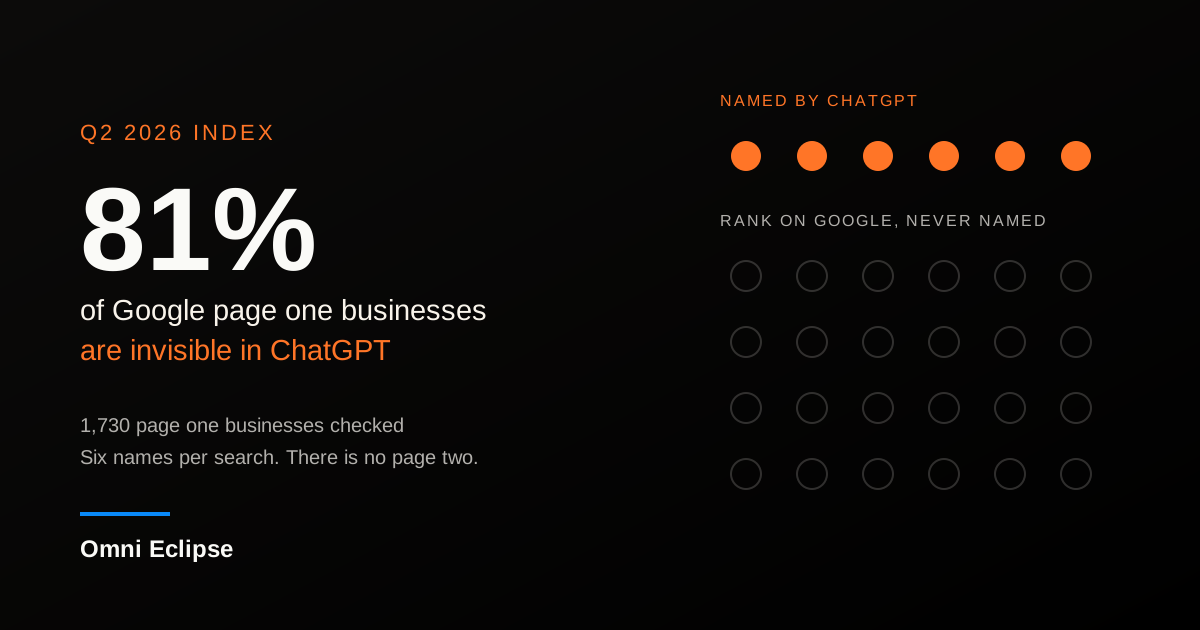
Just 23%. Of the 356 businesses in our dataset that rank on Google page 1, only 82 also appeared in ChatGPT. The remaining 274 are invisible in AI search despite holding a premium Google position.
This is the finding that should reshape how businesses think about search investment. Google page 1 has been the gold standard of digital marketing for two decades. Entire industries are built around getting there. But a Google page 1 ranking does not automatically translate to AI search visibility. 77% of page 1 businesses are proof of that.
The disconnect makes sense when you understand how AI search works differently from traditional search. Google ranks pages based on links, domain authority, and content relevance. ChatGPT selects recommendations based on entity recognition, review aggregation, citation frequency across the web, and structured business data. A business can have excellent SEO and still be invisible to AI because the signals ChatGPT uses are fundamentally different from the signals Google uses. For a deeper comparison, see our AEO vs SEO guide.
Does Paying for Google Ads Help You Appear in AI Search?
No. Of the 126 businesses in our dataset that run Google Ads, only 5 also appeared in ChatGPT. That's a 96% invisibility rate among advertisers.
This finding is particularly important for businesses spending significant budgets on paid search. Google Ads and AI search visibility operate on entirely separate systems. Google Ads is an auction-based placement system. ChatGPT recommendations are based on training data, real-time web retrieval, and entity understanding. Paying Google does not influence what ChatGPT recommends.
Google Ads and AI search visibility are entirely separate channels with different ranking signals. A business spending $10,000 per month on Google Ads has no advantage in ChatGPT over a competitor spending $0 on ads. AI visibility requires a different strategy entirely: structured data, review presence, citation building, and content optimized for AI extraction. Learn more in our guide on how to rank in ChatGPT.
Gartner predicts traditional search engine volume will drop 25% by end of 2026 due to AI chatbots. As that shift accelerates, businesses relying solely on Google Ads will find themselves paying more for a shrinking audience while missing the growing AI search channel entirely.
Which Industries Have the Highest AI Search Visibility?
Architecture firms in the UAE lead our dataset at 31.4%, followed by luxury car dealerships (30.0%) and dental clinics (29.4%). But even the best-performing industries have roughly 2 in 3 businesses invisible. No industry in our study exceeds 32% visibility.
At the other end, three industries recorded 0% AI visibility: roofing (US), solar installers (Australia), and private schools (UAE). Not a single business in these verticals appeared in ChatGPT's recommendations.
| Industry | Country | Visible | Checked | Rate |
|---|---|---|---|---|
| Architecture Firms | UAE | 11 | 35 | 31.4% |
| Luxury Car Dealerships | UAE | 3 | 10 | 30.0% |
| Dental / Dentists | UAE | 10 | 34 | 29.4% |
| Buyers Agents | Australia | 19 | 67 | 28.4% |
| Building Inspectors | Australia | 5 | 20 | 25.0% |
| Fertility Clinics | UAE | 5 | 21 | 23.8% |
| Management Consulting | UAE | 7 | 35 | 20.0% |
| Interior Design | AU, UAE | 7 | 42 | 16.7% |
| Plastic Surgery | US | 6 | 36 | 16.7% |
| Mortgage Brokers | AU, UAE | 9 | 58 | 15.5% |
| ... | ... | ... | ... | ... |
| Funded SaaS | Global | 10 | 148 | 6.8% |
| Conveyancers | Australia | 5 | 78 | 6.4% |
| Real Estate | UAE, US | 14 | 199 | 7.0% |
| Preschools | UAE | 1 | 21 | 4.8% |
| Insurance Brokers | AU, UAE | 7 | 91 | 7.7% |
| Accounting / Tax | AU, UAE | 5 | 97 | 5.2% |
| Private Schools | UAE | 0 | 10 | 0.0% |
| Solar Installers | Australia | 0 | 17 | 0.0% |
| Roofing | US | 0 | 19 | 0.0% |
The pattern that emerges: industries with strong review ecosystems, niche specialization, and clear brand differentiation perform significantly better than commoditised local services. Architecture firms, dental clinics, and buyers agents tend to have robust Google review profiles, industry directory listings, and media coverage. Roofing companies, solar installers, and insurance brokers tend to compete on price with minimal brand differentiation, thin review profiles, and little media presence.
This aligns with what Yext found in their study of 6.8 million AI citations: 86% of AI citations come from brand-managed sources, split between first-party websites (44%) and business listings (42%). The businesses that appear in ChatGPT are the ones that have invested in their brand presence across these surfaces. The ones that haven't are invisible.
Does AI Search Visibility Vary by Country?
Yes, significantly. The UAE leads our dataset with 14.5% of businesses visible in ChatGPT, followed by Australia at 12.3% and the United States at 7.1%.
| Country | Businesses Checked | Visible in ChatGPT | Visibility Rate |
|---|---|---|---|
| UAE | 690 | 100 | 14.5% |
| Australia | 567 | 70 | 12.3% |
| United States | 283 | 20 | 7.1% |
| Global (SaaS) | 160 | 12 | 7.5% |
The UAE's higher visibility is likely driven by market concentration. Dubai and Abu Dhabi have concentrated business districts with high review density on Google Business Profile. When ChatGPT processes "best [service] in Dubai," it draws from a more defined set of businesses with clearer differentiation signals. The US market, by contrast, is fragmented across hundreds of cities and thousands of competing businesses, making it harder for any single business to emerge as a clear recommendation.
The Global SaaS cohort (7.5%) is notable because these are technology companies with strong web presence and content marketing. Even so, more than 9 in 10 SaaS companies don't appear when someone asks ChatGPT for a recommendation in their category.
For Australian businesses specifically, our data shows that while 84.8% appear on Google, only 12.3% have made the jump to AI search visibility. The gap between Google presence and AI presence is 72.5 percentage points. For a detailed look at what this means for Australian businesses, see our state of AI search in Australia report.
What Makes the Businesses That DO Appear in ChatGPT Different?
The 202 businesses in our dataset that do appear in ChatGPT share several common characteristics. While we can't claim causation from observational data, the patterns are consistent enough to identify what separates the visible from the invisible.
Strong review ecosystems. The visible businesses almost universally have robust Google review profiles, often with 50+ reviews and high ratings. Many also appear on industry-specific directories and review platforms (Trustpilot, ProductReview, industry associations). ChatGPT appears to weight review presence heavily when selecting recommendations.
Niche specialization. Generic service providers rarely appear. "Buyers agent" appears more often than "real estate agent." "Cosmetic clinic" more often than "general practice." ChatGPT seems to favor businesses with clear, specific positioning over those offering broad, undifferentiated services.
Media and citation presence. Visible businesses tend to appear in third-party content: listicles, comparison articles, industry roundups, news coverage. These citations across the web create the entity recognition signals that AI models use to assess authority.
Structured business data. Consistent NAP (name, address, phone) data across directories, schema markup on websites, and claimed business listings all contribute to the structured data layer that AI models draw from. Yext's research shows 42% of AI citations come from business listings, underscoring how important this data layer is (Yext, Oct 2025).
The 0% industries share opposite traits: commoditised services with weak brand differentiation, thin review profiles, minimal media coverage, and inconsistent business data across the web. For a practical guide on building these signals, see our post on how to get your business recommended by ChatGPT.
“44% of consumers now prefer AI search for buying decisions. Traditional search is second at 31%. Brands that are not visible in AI search results risk losing access to a growing share of high-intent consumers.
How Does This Compare to Other AI Search Visibility Studies?
Our study fills a specific gap in the AI search research landscape. Several major studies have examined AI search behavior, but none have taken the ground-level, multi-industry approach we used.
Yext's AI citation study (Oct 2025) analyzed 6.8 million AI citations and found that 86% come from brand-managed sources. Their research answers "where do citations come from?" Our study answers a different question: "who is actually visible?"
BrightEdge reports 40-60% monthly citation churn in ChatGPT, meaning the businesses recommended today may not be recommended next month. Their research tracks volatility for known brands. Ours checks whether businesses appear at all.
Peec AI offers automated brand visibility tracking across AI platforms. Their tool monitors specific brands over time. Our study takes the opposite approach: checking every business in an industry, not just the ones that already know they should be monitoring.
Seer Interactive's CTR study (Sep 2025) found that brands cited in AI Overviews earn 35% more organic clicks and 91% more paid clicks. This reinforces our central finding: visibility in AI search isn't just about AI traffic. It has a multiplier effect on traditional search performance too. And 88% of businesses are missing out on both.
| Study | Focus | Sample | Our Difference |
|---|---|---|---|
| Yext (Oct 2025) | Where AI citations come from | 6.8M citations | We check who is visible, not where citations originate |
| BrightEdge | Citation churn over time | Enterprise brands | We check all businesses in an industry, not just known brands |
| Peec AI | Brand monitoring | Individual brands | We audit entire industries, not pre-selected companies |
| Seer Interactive (Sep 2025) | CTR impact of AI visibility | Google search queries | We measure visibility itself, not its downstream effects |
| Omni Eclipse (Mar 2026) | Ground-level visibility audit | 1,700 businesses, 32 industries | Multi-industry, multi-country, local/SMB focus |
What Should Businesses Do About AI Search Invisibility?
AI search visibility is not an accident. The businesses that appear in ChatGPT have, whether intentionally or not, built the signals that AI models use to select recommendations. The good news: these signals are buildable.
The starting point is understanding where you currently stand. If you're invisible in AI search today, the path to visibility involves building the same characteristics we observed in the 202 visible businesses in our dataset: review presence, niche positioning, citation building, and structured business data.
For a step-by-step approach, we've written detailed guides on how to rank in ChatGPT, how to optimize for Perplexity, and how AI content optimization works. For businesses already investing in SEO, our AEO vs SEO comparison explains what transfers and what doesn't.
The cost of waiting is real. Ahrefs found that AI search visitors convert up to 23x better than organic search visitors (Ahrefs, Jun 2025). Semrush's research shows AI search traffic is 4.4x more valuable than traditional organic (Semrush, Jun 2025). Every month a business remains invisible in AI search is a month of lost high-intent, high-conversion traffic.
Want to see where your business stands?
Book a free AI Visibility Audit. We'll check whether your business appears in ChatGPT, Perplexity, Gemini, and Google AI Overviews, then show you exactly what to do about it.
Book Your AI Visibility AuditFrequently Asked Questions
How did you collect this data?
Between January and March 2026, we manually queried ChatGPT for each industry and location combination using natural buying queries (for example, "best mortgage broker in Sydney" or "best architecture firm in Dubai"). For each business that appeared on Google for that query, we recorded whether it also appeared in ChatGPT's recommendation. Only businesses with a confirmed Yes or No were included. Industries were consolidated from city-level data into parent categories. The study covers 1,700 verified businesses across 32 industries in Australia, the UAE, and the United States.
Does appearing in Google guarantee ChatGPT visibility?
No. This is one of the key findings of our study. 77% of businesses ranking on Google page 1 are invisible in ChatGPT. Google and ChatGPT use fundamentally different signals to select results. Google relies on links, domain authority, and content relevance. ChatGPT draws from entity recognition, review aggregation, web citations, and structured business data. A strong Google ranking is valuable, but it does not automatically transfer to AI search visibility.
Which AI search platforms did you test?
This study focused specifically on ChatGPT, as it holds approximately 68% of the AI chatbot market share (First Page Sage, Feb 2026) with 800 million weekly active users. Other platforms like Perplexity, Gemini, and Google AI Overviews use different retrieval methods and may show different results. We chose ChatGPT because it represents the largest share of AI search queries and consumer buying behavior.
How often does AI search visibility change?
BrightEdge research indicates 40-60% monthly citation churn in ChatGPT, meaning the businesses recommended today may not be recommended next month. AI search visibility is significantly less stable than Google rankings. This makes ongoing monitoring and optimization essential, rather than treating AI visibility as a one-time project.
What can businesses do right now to become visible in AI search?
Start with the fundamentals: build a strong Google review profile (50+ reviews with high ratings), ensure consistent business data across directories, create content that directly answers the questions your customers ask, and build citations across industry-specific platforms. For detailed, step-by-step guidance, see our guides on how to rank in ChatGPT and how to get your Australian business recommended by ChatGPT.

Ashur Homa
Built and scaled a digital brand to $100M+ in sales with zero ad spend. Has helped businesses generate millions through AI go-to-market strategy. Leads growth at Omni Eclipse.
Connect on LinkedIn